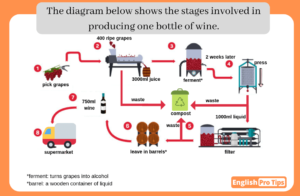
The diagram illustrates the process of producing a bottle of wine, from harvesting grapes to delivering the finished product to supermarkets.
Overall, wine production involves eight stages, beginning with the collection of grapes and ending with distribution. During the process, the grapes are fermented, pressed, filtered and stored in barrels. Waste material generated at several stages is recycled as compost.
First, grapes are picked and approximately 400 ripe grapes are processed to produce around 3,000 millilitres of juice. This juice is then transferred to a fermentation tank, where it is left for two weeks. During fermentation, the grape juice is converted into alcohol.
After the fermentation stage, the mixture is pressed to separate the liquid from the remaining solid material. This produces around 1,000 millilitres of liquid, which is subsequently filtered. Any waste produced during the pressing and filtering stages is sent for composting.
Next, the filtered liquid is stored in wooden barrels for a period of maturation. Once the ageing process has been completed, the wine is bottled, resulting in a standard 750-millilitre bottle of wine. In the final stage, the finished product is transported to supermarkets for sale. Overall, around 400 grapes are ultimately used to produce a single 750-millilitre bottle of wine.