
IELTS Vocabulary Course
-
Course Outline and Content
-
How to Increase your Vocabulary
-
People and Community
Describing People -
Upbringing and Family
-
Health and Happiness
-
Roles and Responsibility
-
Crime
-
Revision: People and Community
-
Geography and The EnvironmentBuildings and Cities
-
The Environment
-
Travel
-
Nature and Wildlife
-
Assessing Efforts
-
Revision: Geography and The Environment
-
Education, Technology and SkillsSkills and learning
-
Education
-
Work
-
Economy
-
Technology
-
Revision: Education, Technology and Skills
-
End of the CourseEnd of the Vocabulary Course, what's next...
- 1 hour
Slow video loading? View the Alternative Video Source
Create an account or login to download the PDF
Word list (20 words)
Lack (verb) /læk/
Not have enough of something that is needed or wanted.
Many international students lack the confidence to speak up in lectures.
- Lack + ability/ experience/ focus/ authority/ knowledge/ the resources + to do (something)
Lack (noun: uncountable): Students often have a lack of sleep.
Pressure (noun: countable + uncountable) /ˈpreʃə(r)/
A difficult situation that makes you feel worried or unhappy
Regular exams can put students under an enormous amount of pressure.
- under + pressure + from (something)/ as a result of (something)
- put/ apply + pressure + on (someone/something)
- peer/ government/ societal/ parental/ financial + pressure
- enormous/ considerable + pressure
Pressure (verb): Activists pressure the government to change their policies.
Pressurised (adjective): Some students perform their best in pressurised situations. (US spelling: pressurized)
Tertiary/ Further education (adjective + noun) /ˈtɜːʃəri/
Further education is for people who have left secondary school but below university education. Tertiary education is college or university level.
Most high school graduates go on to study at university or some other form of tertiary education.
Post-school life (adjective + noun phrase) /pəʊst skuːl laɪf/
Life after school. ‘Post’ means after. So, you can say, post-school, post-war, etc.
Do teachers or parents better prepare students for post-school life?
Evidence (noun: uncountable) /ˈevɪdəns/
Reason(s) that prove a belief.
There is considerable scientific evidence showing the negative health effects from lack of sleep.
- scientific + evidence
- find/ show/ give/ provide/ obtain/ draw on/ base on + evidence
- evidence + suggest/ show/ indicate
- ample/ considerable/ strong sufficient + evidence
Evident (adjective): It’s evident from her change in behaviour that she’s not happy at school.
Theoretical (adjective) /ˌθɪəˈretɪkl/
Based on the ideas that relate to a subject, not the practical uses of that subject.
Students graduate from university with theoretical knowledge of their subject but insufficient practical experience.
- theoretical + subject/ argument/ study/ knowledge/ basis/ approach/ perspective
Theoretically (adverb): Theoretically a country should be able to have full employment however, this is rarely the case.
Practical (adjective) /ˈpræktɪkl/
Relating to experience, real situations, rather than ideas or imagination.
I would argue that practical work experience is more valuable than academic qualifications and theoretical knowledge of a subject.
- practical + experience/ difficulty/ problem/ purpose/ advice/ implication/ skill/ work/ subject/ help
Innovation (noun: countable + uncountable) /ˌɪnəˈveɪʃn/
A new idea or method.
Everyone benefits from innovation in healthcare technology.
- major/ significant/ recent/ educational/ technological + innovation
- Innovation + in (something)
Innovate (verb): The tech industry is always trying to innovate.
Innovator (noun: countable): Schools should develop students into fearless innovators.
Innovative (adjective): Schools should encourage innovative thinking.
Patent (noun: countable) /ˈpætnt/
The legal right to make or sell an invention.
Private companies protect their innovations behind complex patents.
- take out/ file/infringe + patent
- patent + on (something)/ for (something)
Patent (verb): An invention is not your own until it’s patented.
Breakthrough (noun: countable) /ˈbreɪkθruː/
An important discovery or event that helps to improve a situation or provide an answer to a problem.
Breakthroughs in medicine have meant that we have an aging population.
- make + breakthrough
- major/ significant/ scientific/ technological + breakthrough
Eligible (adjective) /ˈelɪdʒəbl/
Having the necessary qualities or satisfying the necessary conditions.
Only people over 18 are eligible to vote.
- eligible + to (do something)/ for (something)
Eligibility (noun: uncountable): The eligibility rules prevent under-18s from being able to vote.
Procrastinate (verb) /prəˈkræstɪneɪt/
To delay or postpone action often because it is unpleasant or boring.
Many students get distracted by their smartphones when they should be studying and end up procrastinating.
Procrastination (noun: uncountable): Students should be taught techniques to avoid procrastination.
Compulsory (adjective) /kəmˈpʌlsəri/
If something is compulsory, you must do it because of a rule or law.
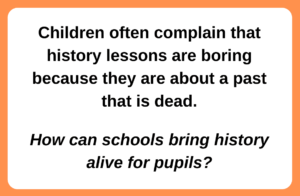
Schools often make history a compulsory subject at school, but is it still important to learn about the past?
- compulsory + subject/ purchase/ education
Curriculum (noun) /kəˈrɪkjələm/
The subjects studied in a school, college, etc. and what each subject includes.
Some people argue that practical subjects such as art and music should not be in the school curriculum.
- develop/ follow + curriculum
- national/ education/ school + curriculum
A feature (noun) + of (working life/ education) /ə ˈfiːtʃə(r) əv/
A typical quality or important part of something.
Long hours and little family time is becoming a common feature of working life.
- distinctive/ notable/ particular/ prominent/ special/ striking/ central/ important/ key/ main/ common + feature
- feature + of (something)
Demonstrate (verb) /ˈdemənstreɪt/
To show or make something clear.
Research has demonstrated that babies can recognise their mother’s voice very soon after birth.
- demonstrate + a skill/ ability/ (something)
- clearly + demonstrates
- demonstrates + by (some way)
Competence (noun: countable + uncountable) /ˈkɒmpɪtəns/
The ability to do something well.
Studying abroad is an effective way of improving foreign language competence.
- develop/ improve + competence
- competence + in (something)
- degree of/ level of/ standard of + competence.
Cram (verb) /kræm/
To try to learn a lot very quickly before an exam.
Regular tests force students to focus on cramming for exams rather than learning.
- cram + for (something)
Distance learning (noun: uncountable) /ˈdɪstəns ˈlɜːnɪŋ/
A way of studying where you study mostly from home via the internet.
Distance learning has become a regular feature of the UK’s education system enabling students to access lectures and attend classes from anywhere in the world.
Vocational course (noun: countable) /vəʊˈkeɪʃənl kɔːs/
Providing skills and education that prepare you for a job.
Many young people choose to do vocational courses rather than going to university.
Collocations
- Verb + course: complete/ develop/ run/ offer/ attend/ access + course
- Adjective + course: practical/ academic/ compulsory/ crash/ full-time/ part-time/ intensive/ vocational/ specialised + course
- Course + verb: course + covers/ includes
- Verb + education: improve/ promote/ provide/ receive + education
- Adjective + education: elementary/ primary/ higher/ secondary/ tertiary/ postgraduate/ vocational/ advanced/ formal/ full-time/ part-time + education
- Education + noun: education + system/ institution/ grant
- Noun + education: access to/ approach to/ level of/ standard of/ need for + education
Personalise the vocabulary
A proven way to learn vocabulary is to personalise it. Type your answers into this form and print it off as study material. You can also practice these IELTS style questions with a partner. You can only save and print your answers if you do this activity on a computer (not a mobile phone). You will not get tutor feedback on your answers. This activity is simply for you to practice the vocabulary.